
How to Search Boulder County Court Records
Boulder County Court records start with the Colorado Judicial Branch because Boulder County is the 20th Judicial District. Use the Colorado Judicial Branch docket search for hearing dates, court dates, and docket settings. Use Colorado State Courts Data Access or CoCourts for public case data when a full case document is not needed. Actual copies and certified records come from the Boulder County Combined Court Research Department.
A strong Boulder County Court records search begins with the court level. District Court handles felonies, divorce, probate, juvenile, mental health, and higher civil cases. County Court handles state misdemeanors, traffic, small claims, protection orders, and lower-value civil cases. Municipal courts in Boulder and Longmont keep city traffic, parking, photo enforcement, ordinance, and municipal misdemeanor matters outside the state court case system.
- Identify the court level before searching. Felony, divorce, probate, juvenile, and major civil files usually point to District Court.
- For hearing dates, open the Colorado docket search and select a date plus at least one more filter.
- Choose 20th Judicial District, Boulder County, and the Boulder or Longmont combined-court location when known.
- For case data beyond a docket, use State Courts Data Access or CoCourts and save the case number and party names.
- For documents, older files, or certified copies, email 20recordsrequest@judicial.state.co.us or call 720-664-1468.
The 20th Judicial District local court page confirms that case records should be requested by email from the Research Department. It also lists filing channels, transcript instructions, court resource center details, and the local text reminder program for covered criminal and juvenile case types.
The official Boulder County trial court page shows the state court access point for Boulder County residents.
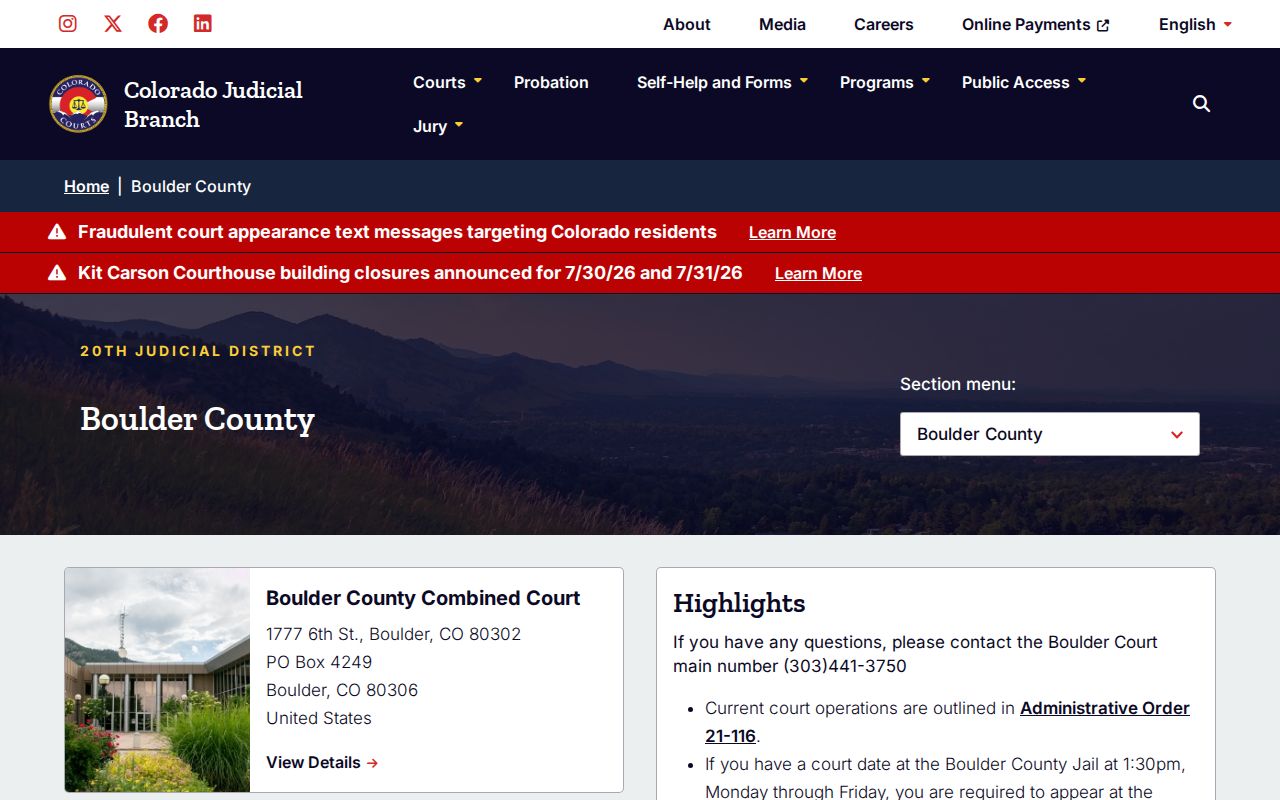
That local court page is the best starting point when an online docket entry is not enough and a case copy is needed.
The Boulder County Judicial System
Boulder County is the whole 20th Judicial District, so the county and district identity overlap. The state court hierarchy runs from trial courts to the Colorado Court of Appeals and the Colorado Supreme Court. District Court is the general-jurisdiction trial court. County Court is a limited-jurisdiction trial court. Municipal courts are separate city courts, even when a municipal charge looks similar to a state misdemeanor or traffic charge.
District Court Chief Judge Nancy W. Salomone is listed for Division 13 on the Boulder County judges and staff page. County Court divisions 7 through 11 handle limited-jurisdiction state matters. Boulder Municipal Court and Longmont Municipal Court are not part of the Boulder County Combined Court, so their cases may not appear in the same search path.
Case flow: Municipal or County Court for lower matters › District Court for general jurisdiction and appeals from County Court › Colorado Court of Appeals › Colorado Supreme Court.
| Court | Jurisdiction | Case Types |
|---|---|---|
| Boulder County District Court | General trial jurisdiction | Felony, civil, domestic relations, juvenile, probate, and mental health cases |
| Boulder County Court | Limited state trial jurisdiction | Misdemeanors, traffic, small claims, protection orders, and civil cases under the county-court threshold |
| Municipal Courts | City ordinance jurisdiction | Municipal traffic, parking, photo enforcement, animal, and local misdemeanor cases |
The Colorado Judicial Branch public access guide explains how statewide court access rules frame public records in Boulder County.
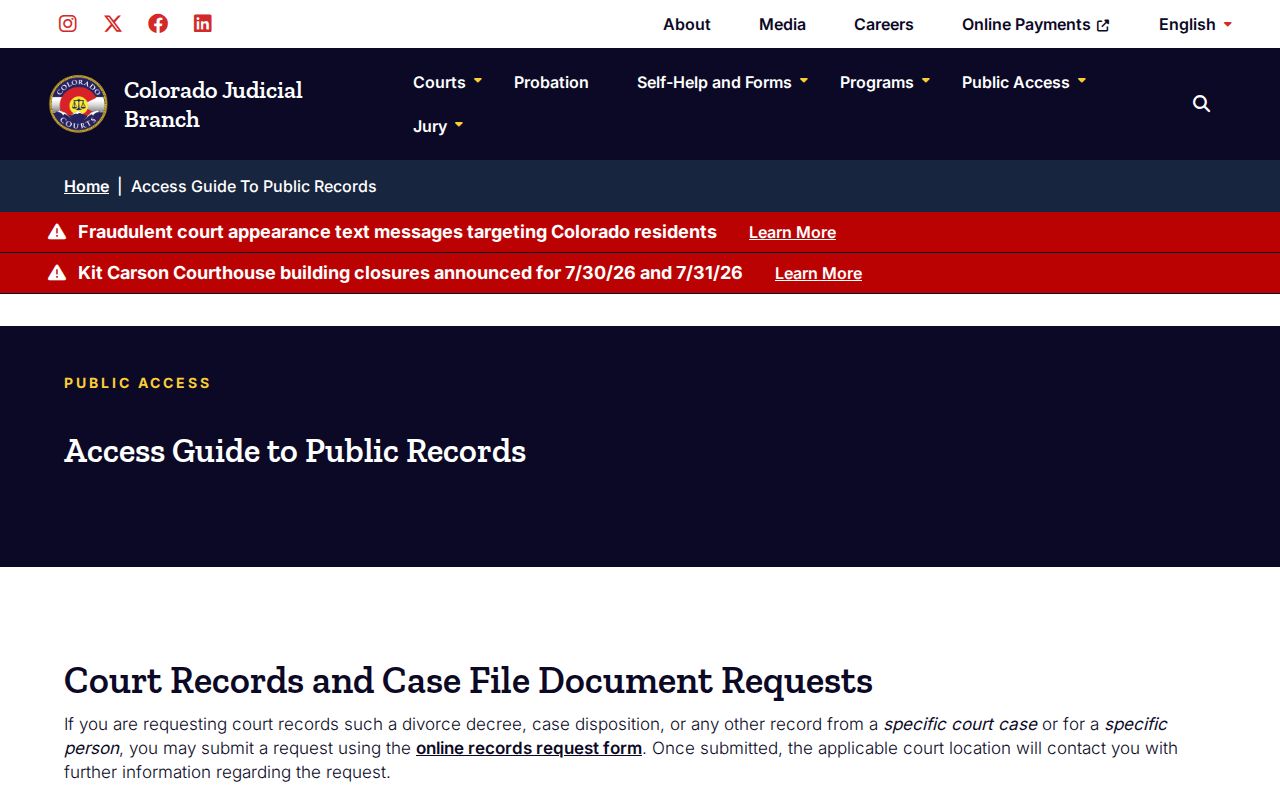
The guide helps separate court case records from administrative judicial records and from county agency records.
Boulder County Courthouses
The main state court records counter is the Boulder County Combined Court at 1777 6th Street in Boulder. It houses District Court and County Court operations, case filings, records requests, jury functions, the Court Resource Center, and family-court facilitator services. The historic courthouse at 1300 Pearl Street is important to county history, but it is not the main state case-record counter.
20th Judicial District Research Department
1777 6th Street
Boulder, CO 80302
720-664-1468
20recordsrequest@judicial.state.co.us
Boulder County's official overview describes a county that spans plains, foothills, mountain areas, and cities such as Boulder, Longmont, Lafayette, Louisville, Lyons, Nederland, Superior, Niwot, and Gunbarrel.
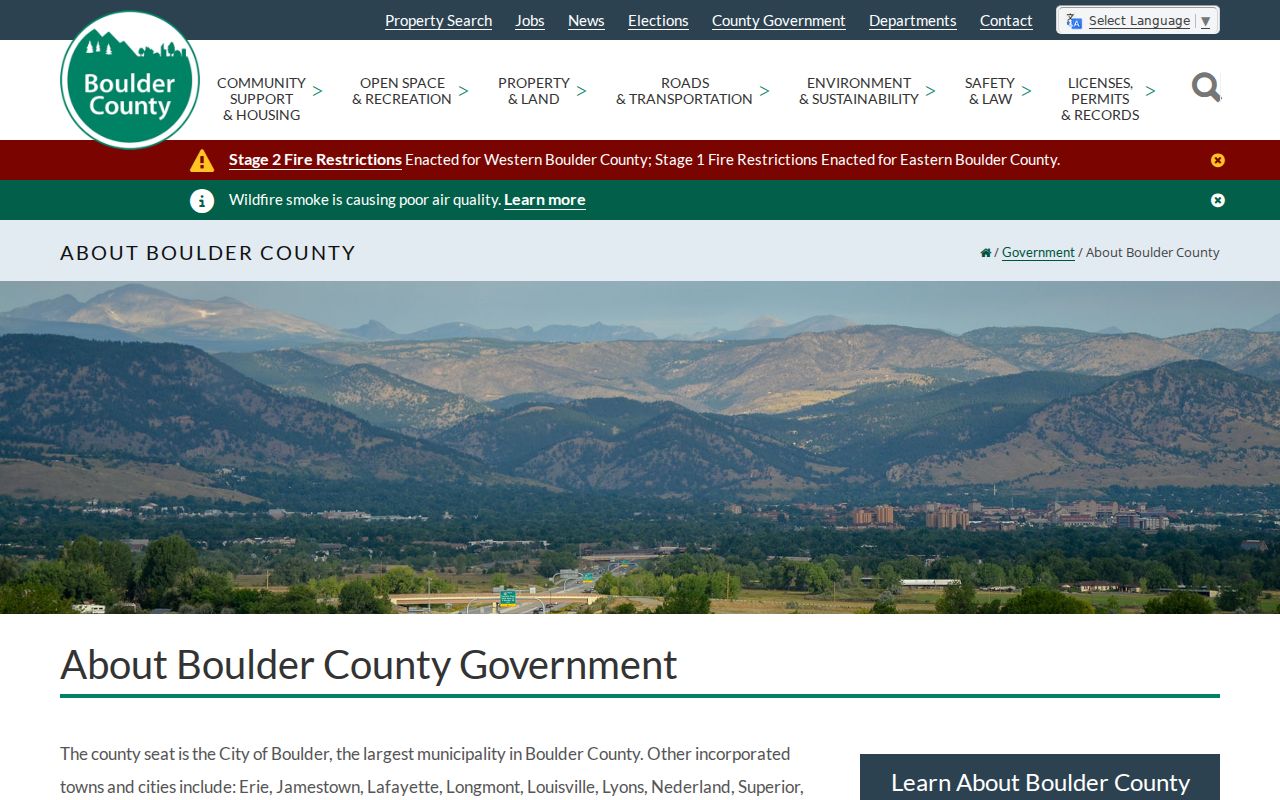
That geography is why email, phone, mail, municipal, and statewide access channels matter alongside the courthouse counter.
Types of Court Records Available in Boulder County
Boulder County Court records include civil, criminal, domestic relations, probate, traffic, juvenile, protection-order, and small-claims files. Some records are public at the case level but still have sealed documents, redactions, or restricted party information. Online dockets often show events and hearings rather than every pleading or order.
The record type usually tells you the office to contact. Court pleadings, judgments, warrants entered in a case, divorce files, and probate events go through the Combined Court. Recorded deeds, liens, marriage licenses, and certified marriage copies go through the Boulder County Clerk and Recorder. Jail records and investigative reports go through the Sheriff.
- Criminal records - District Court handles felonies, while County Court handles state misdemeanors and traffic matters.
- Civil records - District Court handles civil cases in any amount, and County Court handles lower-value civil cases and small claims.
- Family and divorce records - Domestic relations cases are District Court records, with some child, financial, and protected-address details restricted.
- Probate records - Estate, guardianship, and conservatorship files are handled by the Probate Division of District Court.
- Traffic records - State traffic cases are usually County Court records, while municipal tickets stay with the issuing city court.
The Boulder County Clerk and Recorder PublicSearch portal is useful for recorded documents, not state court case files.
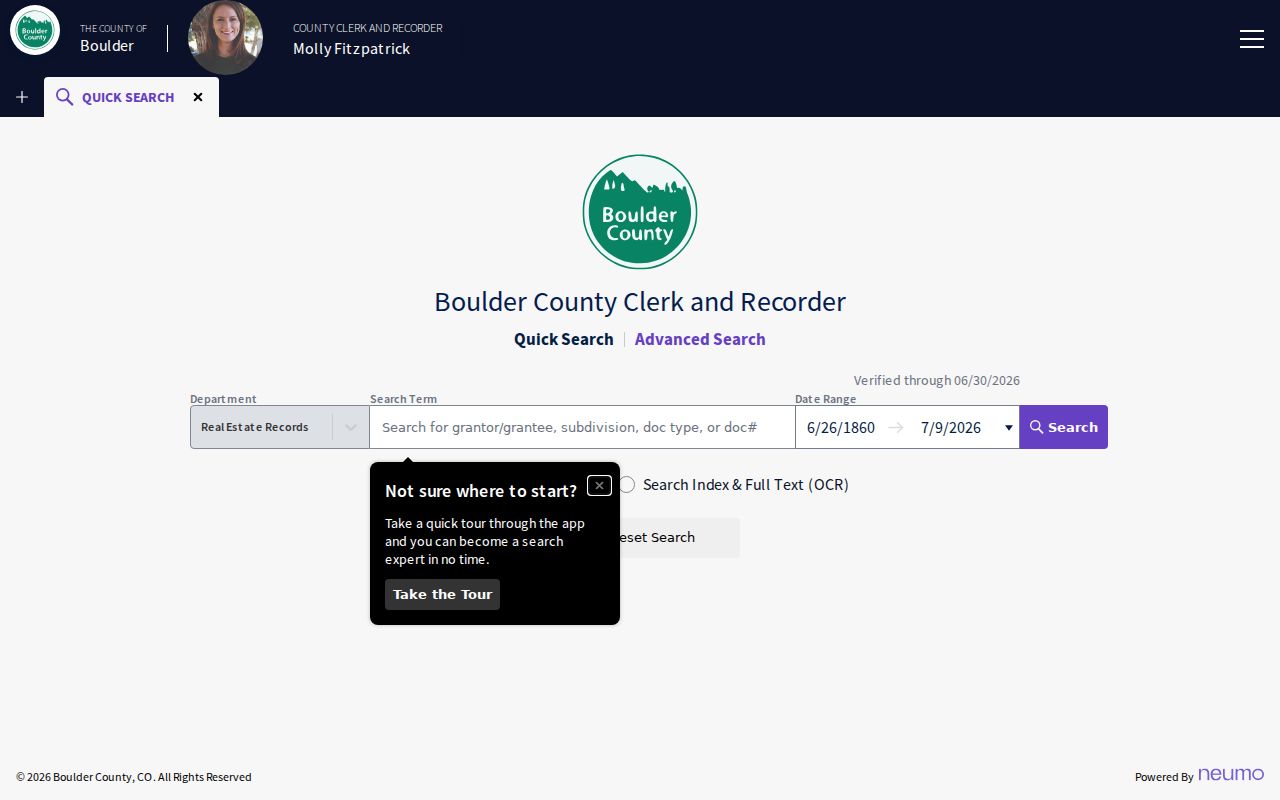
This distinction prevents a common mistake: searching the recording system for a docket, divorce decree, or criminal case file.
What Boulder County Court Records Show
A Boulder County Court record may show the case number, court location, case class, parties, attorneys, filing date, docket events, hearings, disposition, financial entries, and available document references. Criminal matters may show charge text, plea, sentence, probation, restitution, or bond entries. Civil matters may show complaint, answer, motions, orders, judgment, satisfaction, and collection events.
| Field | What It Shows |
|---|---|
| Case Number | Colorado case identifier with year and class such as CR, M, T, CV, DR, JD, JV, or PR. |
| Filing Date | Date the complaint, petition, information, citation, or other opening document was filed. |
| Parties | People, plaintiff, petitioner, defendant, respondent, estate, ward, or interested persons. |
| Charges / Cause | Criminal charge, traffic offense, civil claim, probate matter, protection order, or domestic-relations issue. |
| Disposition | Dismissed, guilty plea, judgment entered, decree entered, deferred judgment, transferred, sealed, or closed. |
| Sentence / Judgment | Fine, costs, restitution, probation, jail, judgment amount, order, decree, or satisfaction entry. |
The Colorado Judicial Branch docket search is the primary public place to check Boulder County Court hearing dates.
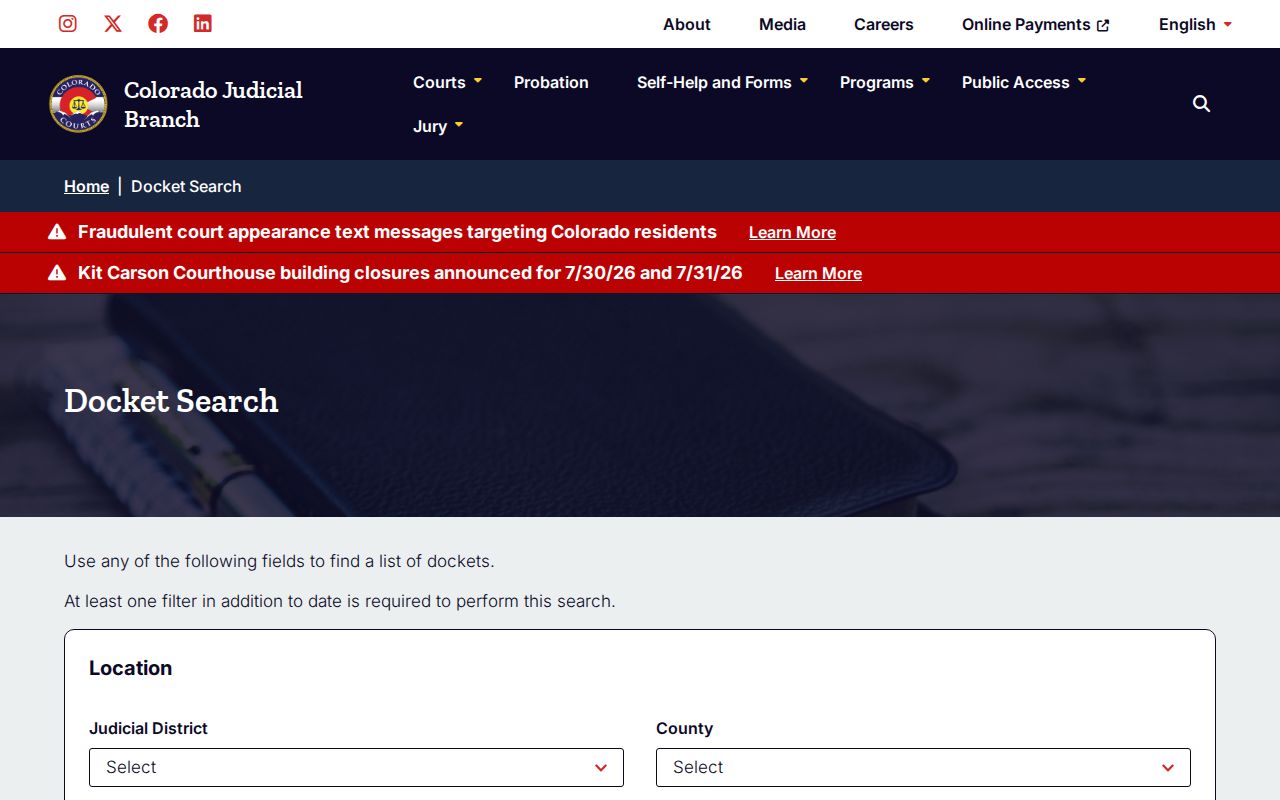
Docket search results are useful for schedules, but document images and certified copies still require a court records request.
Public Access Laws for Boulder County Court Records
Boulder County Court records are not governed by one simple open-file rule. Colorado Judicial Branch court case access is framed by CJD 05-01 and court public-access rules. Agency records, such as Sheriff investigative records, may involve the Colorado Criminal Justice Records Act. County administrative records may involve the Colorado Open Records Act. Each custodian applies the rule set tied to the record it holds.
Key Statutes:
CJD 05-01 and P.A.I.R.R. - Court records are open only as allowed by Colorado court rules, directives, statutes, and court orders.
C.R.S. § 24-72-201 et seq. - CORA governs many Colorado government records, but court case files follow court-specific rules.
C.R.S. § 24-72-301 et seq. - Criminal justice records rules apply to many law-enforcement and Sheriff records.
C.R.S. § 24-72-305.5 - Boulder Sheriff records requests require a signed statement against direct business solicitation.
Records That Are Restricted or Confidential
Restricted Boulder County Court records can include juvenile matters, sealed criminal cases, adoption files, mental health proceedings, protected-party information, protected addresses, victim information, medical details, and financial account data. A public docket may omit a case, hide a name, show only limited event text, or require a clerk review before any copy is released.
Sealing rules depend on the case result and offense type. Colorado materials identify different paths for acquittals, complete dismissals, completed diversion, completed deferred judgment, eligible convictions, and automatic sealing under specified statutes. If a Boulder County case needs sealing or unsealing action, filings go through the 20th Judicial District Clerk's Office and may also require notice to outside record custodians.
Boulder County Diversion Programs
Boulder County research did not confirm a current official stand-alone veterans treatment court, DUI court, or mental health court page with eligibility rules. The strongest local specialty material is the District Attorney diversion and deferral path. A referred person must contact the DA Diversion Program at 303-441-1212 or diversion@bouldercounty.gov within three days after the court appearance to schedule screening.
The 20th Judicial District Attorney diversion and deferral dashboard covers cases where the DA granted alternatives to traditional prosecution. Diversion can change how a charge appears later because successful completion may lead to dismissal or sealing eligibility. Jail programming also matters after booking. Boulder County Jail offers education, behavioral health, substance-use treatment, reentry planning, Social Security card support, and DMV2GO state ID visits in odd-numbered months.
Boulder County Sheriff and Jail
The Boulder County Sheriff's Office headquarters is at 5600 Flatiron Parkway in Boulder, and the jail is at 3200 Airport Road. Sheriff Curtis Johnson is listed on the command staff page. The jail opened in 1988, has a listed capacity of 287, and houses people across security levels. Current custody details may appear in the jail listing with charges, daily booking reports, and release reports.
Use the official jail listing for custody checks and the Sheriff Records Section for jail records, investigative records, CAD, mugshots, or body-worn camera material. Sheriff records requests may involve the GovQA request form, hourly research fees, and a signed statement required by Colorado criminal justice records law. The full roster process is covered in Boulder County inmate records.
The Boulder County Sheriff homepage lists Sheriff, jail, and communications center contacts.
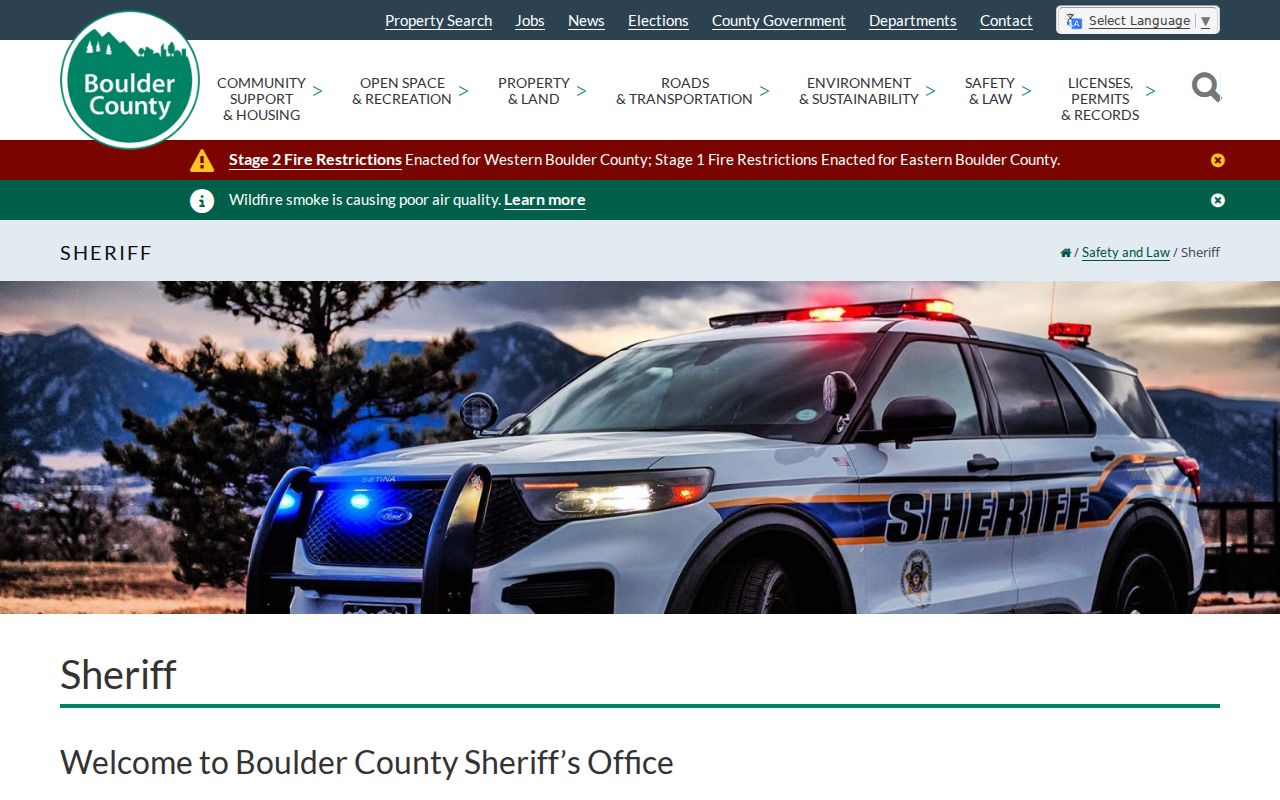
Sheriff records are part of the access picture, but they are separate from District Court and County Court case files.
The Boulder County Jail overview gives the facility context behind custody and booking records.
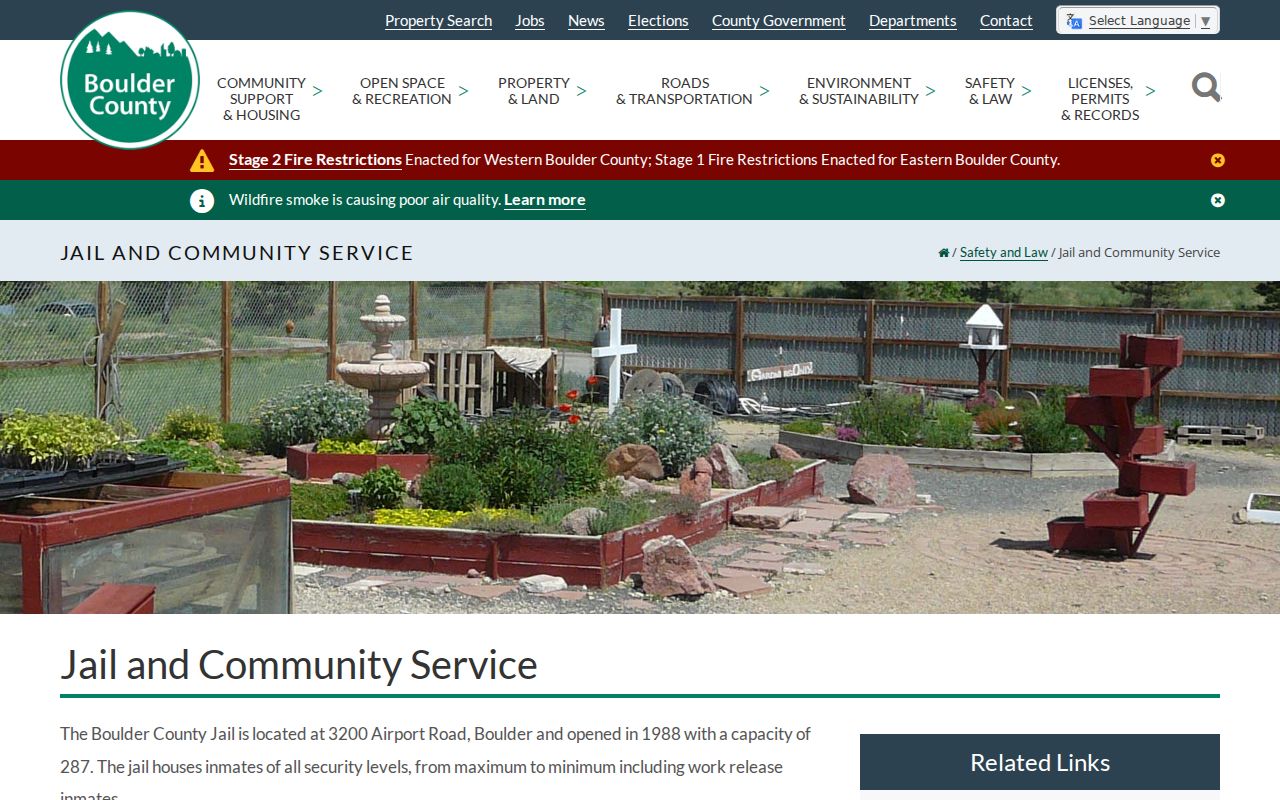
The jail page helps explain why a booking entry, a court charge, and a final criminal disposition are different records.
Marriage, Divorce, and Probate Division of District Court
Marriage licenses and civil union licenses are Clerk and Recorder records in Boulder County, while divorce is a District Court domestic relations case. That split is easy to miss because both can involve family status. Probate is also in District Court through the Probate Division of District Court, not a separate county probate court.
Boulder County's marriage records have unusual local history. Historic county courthouse materials note that Clerk Clela Rorex issued the first same-sex marriage license in the nation in 1975 from the historic courthouse at 1300 Pearl Street. Current license applications are handled through the Recording Division's online and appointment process.
- Testator
- Person who made a will.
- Personal representative
- Person appointed to manage an estate in probate.
- Conservator
- Person appointed to manage financial affairs for a protected person.
The Boulder County District Attorney page is relevant when criminal charges, diversion, and court outcomes intersect with family or custody issues.
District Attorney records do not replace the court file, but charging and diversion decisions shape what the court record later shows.
Boulder County Court Records Fees
The research captured exact copy fees for the Boulder County Clerk and Recorder, but not exact current court-copy fees from the Colorado Judicial Branch fee list. Do not assume the recording fee table applies to District Court pleadings or County Court case files. For court documents and certified case copies, ask the 20th Judicial District Research Department for the current cost before ordering.
| Item | Amount |
|---|---|
| Letter-size recorded-document copy | $0.25 per page, postage additional |
| Recorded-document certification | $1.00 per document, mail only, postage additional |
| Certified marriage certificate | $1.25 each, mail only, postage additional |
| Sheriff Records research and retrieval | $40 per hour of staff time |
| Credit-card payment to Sheriff Records | $0.75 base charge plus 2.25% through vendor |
How to Interpret Boulder County Court Records
Colorado case classes are short labels, and they matter. CR often indicates a felony criminal case, M a misdemeanor, T a traffic matter, CV a civil case, DR a domestic relations case, PR a probate matter, and JD or JV a juvenile matter. A docket entry is a timeline item. A document is the actual pleading, order, motion, or judgment behind an event.
A charge is not the same thing as a conviction. A Boulder County jail listing can show an arresting charge before the District Attorney files or changes the charge. A criminal court record then tracks plea, amendment, dismissal, deferred judgment, verdict, sentence, or closure. The record should be read from the most recent court disposition, not just the first booking or complaint entry.
Accuracy and Record Limitations
Online Boulder County Court records can lag behind courtroom activity, clerk entry, jail release timing, payment posting, or sealing orders. The Sheriff citation payment page says Boulder County Sheriff's Office citations can take 2-4 business days to become available for payment. Longmont municipal payment rules require full payment by 5:00 p.m. the day before court when a person is eligible to resolve the citation without appearing.
Errors should be routed to the custodian that created the record. Court case errors go to the Combined Court. Sheriff custody, investigative, or CAD records go to Sheriff Records. Recorded-document indexing issues go to the Clerk and Recorder. DMV driver history errors are separate from court traffic files and must be handled through DMV channels.
Note: Confirm court dates, balances, warrants, and custody status with the issuing office before relying on an online result.
History of Boulder County Courts
Boulder County's historic courthouse is directly tied to record history. County materials say the original courthouse was built in 1882 by F.E. Edbrooke, destroyed by fire in 1932, and replaced in 1933 with a Works Progress Administration Moderne building designed by Glen H. Huntington. The Secretary of the Interior designated the historic courthouse a National Historic Landmark in December 2024 because of its role in LGBTQ+ equality.
The 1975 marriage license issued by Clerk Clela Rorex connects a local county record to national civil-rights history. Today, the working state court records counter is the Boulder County Combined Court at 1777 6th Street, while the historic courthouse remains a county landmark and symbol of marriage-license history.
Frequently Asked Questions
Where are Boulder County Court records kept?
State court case records are kept by the Boulder County Combined Court and 20th Judicial District, not by the Boulder County Clerk and Recorder. Use the Research Department for copies and certified documents.
Can I search Boulder County Court records online?
Yes, but online tools have limits. Docket dates are searched through Colorado Judicial Branch docket search. Public case data may be available through State Courts Data Access or CoCourts. Case documents usually require a court records request.
Are Boulder municipal tickets in County Court?
Not usually. City of Boulder Municipal Court handles city ordinance, municipal traffic, photo enforcement, parking, animal, and municipal misdemeanor matters. State tickets marked for Boulder County Court follow the state court path.
Who handles Boulder County marriage records?
The Boulder County Clerk and Recorder handles marriage and civil union licenses and copies. Divorce files are different. They are District Court domestic relations records requested through court channels.
Is there a public Boulder County active warrant search?
The research did not locate an official live public active-warrant search for Boulder County. Check the issuing court, the Sheriff, municipal courts, or jail booking records depending on the warrant type.
How do I get a certified court copy?
Email 20recordsrequest@judicial.state.co.us with the case number, party names, approximate filing year, record type, and whether a certified copy is needed. Call 720-664-1468 for older or uncertain files.